
30 October 2026
Bulk Fermentation Temperature: Adjust Every Bake
By Fredrik
Bulk fermentation temperature, not a fixed time chart, determines when your dough is ready: as a working rule, each band of dough temperature shifts bulk ferment time by roughly 25–30%, so 26°C dough needs about half the time of 18°C dough. Read your dough temperature, apply a percentage adjustment, then rebalance starter or water temperature to hit your target. This gives you one repeatable process for whatever your Swedish kitchen throws at you, summer or winter.
This article builds on fermentation research, including De Vuyst & Neysens (2005) and Gänzle (2014).
Temperatures that work
Cool bulk, more tang · 18–22 °C
Dough, everyday bake · 24–28 °C
Dough water · 25–28 °C
What is the ideal bulk fermentation temperature for sourdough?
There is no single ideal number. For standard weekly bakes, aim for 24–28°C dough temperature. For flavor-forward cold bulk, 18–22°C gives lactic acid bacteria more relative influence, which shifts the crumb and tang of the loaf. Which range fits depends on your schedule and what you want the bread to taste like, not on a chart.
Why most recipes assume 24–26°C
Recipe timings are written for a warm, comfortable kitchen. Yeast activity roughly doubles with every 8–10°C rise and slows sharply as dough cools, so a recipe tested at 25°C will run long in a 19°C Swedish kitchen (overview of sourdough fermentation). If your kitchen sits below 22°C for much of the year, the printed bulk time is a starting guess, not a plan.
What changes when you bake outside that range
Below the recipe's assumed range, bulk stretches out, gluten keeps developing during the long ferment, and flavor deepens. Above it, bulk compresses, and dough can over-acidify and slump before you notice. The fix is not a new recipe but a temperature-compensation habit: read the dough temperature, adjust the time, and use starter percentage or water temperature to steer toward a target. Logging each bake against its temperature is what turns that into a repeatable routine you can track in DEGA.
How much does bulk fermentation time change per degree of dough temperature?
A workable rule of thumb: every 3–4°C shift in dough temperature changes bulk fermentation time by roughly 20–30%. These bands are illustrative, drawn from common baker guidance rather than a single source, so treat them as starting points and log your own results.
The adjustment bands: 18–21, 22–25, 26–28, 29–30°C
Assume a baseline of 24°C with a 4-hour bulk using 20% starter. At each band, multiply that baseline by the percentage shown. The colder bands need a proportionally longer time; the warm bands shorten fast.
Why the relationship is not linear
Yeast activity roughly doubles per 10°C rise, so time does not scale evenly with degrees. Extrapolating linearly from 22°C to 30°C will under-ferment your dough badly. The bands compress at the warm end because fermentation accelerates sharply there, which is also why 29–30°C bakes drift toward sour, slack dough if you walk away.
A table of bands with % time change and worked example at each
| Dough temp | Time change vs 24°C baseline | Worked example (4 h baseline) |
|---|---|---|
| 18–21°C | +40–60% | 5 h 40 m–6 h 25 m |
| 22–25°C | baseline ±10% | 3 h 40 m–4 h 25 m |
| 26–28°C | −20–30% | 2 h 50 m–3 h 15 m |
| 29–30°C | −40–50% | 2 h–2 h 25 m |
Check the dough, not the clock: these numbers get you close, then volume and feel decide when to shape.
How do I adjust starter percentage or water temperature to hit a target dough temperature?
The DDT formula in plain numbers
Desired dough temperature (DDT) is simple arithmetic: take your flour temperature and water temperature, average them, add a friction factor from mixing, and compare the result to your target. Most home bakers kneading by hand can assume a friction factor near 0; a stand mixer adds a few degrees. King Arthur Baking's dough temperature guide walks through the same calculation.
Changing starter percentage instead of water temperature
Cold tap water in a Swedish winter kitchen only gets you so far, and warm water in summer can push hydration too high. Raising starter percentage works instead: more starter means faster fermentation at the same dough temperature, so you can accept a cooler dough and still finish bulk in reasonable time. The trade-off is more sourness and a shorter window at peak.
Worked example: 18°C kitchen, 20% starter vs 10% starter
Say your kitchen sits at 18°C, flour is 19°C, and your target dough temperature is 24°C. Water needs to be about 29°C ((19 + 29) / 2 = 24). With 10% starter, bulk at 24°C might run four hours. Drop to 20% starter and you can let the dough sit at 22°C (water at 25°C) and land near the same finish time, since doubling the starter roughly halves the fermentation lag. Both routes hit the target; the 20% bake will taste tangier and demand closer attention near peak.
What happens to gluten and flavor at cold bulk fermentation temperatures (18–22°C)?
Yeast and lactic acid bacteria work at different speeds
Yeast slows down faster than bacteria as temperature drops. At 18°C your gas production might drop by half or more compared to 26°C, but the bacteria keep working, so bulk fermentation takes far longer while acid production continues in the background. Cooler temperatures also shift the balance toward more acetic acid, which reads as a sharper, more sour flavor. Warmer doughs lean lactic and taste milder.
The practical consequence: at 18–22°C you get a longer window between "barely risen" and "overdone," but the gluten also relaxes more slowly, so structure builds late. Handle gently, since a cold dough tears more easily during stretch and folds.
When cold bulk improves the loaf and when it just slows you down
Cold bulk suits whole grain doughs and strong flours, where the extra time deepens flavor without collapsing structure. It works against you when your starter is sluggish or your flour is weak: you wait hours longer and gain little. If your kitchen sits at 18°C in winter, either extend bulk substantially, raise the starter percentage, or use warm water to pull the dough temperature up before committing to the long version.
How do I tell bulk fermentation is done when fermenting at a non-standard temperature?
When temperature shifts, the clock lies. A bake that takes 4 hours at 26°C can take 7 or more at 18°C, so stop watching time and start watching the dough. Volume is the cue that matters most: aim for a 50–75% rise during bulk, not a doubling. Surface bubbles and a jiggle that wobbles like set custard rather than a slack batter back it up.
Volume gain as your primary cue
Mark the starting dough height, then judge progress against that line, not the clock. At cooler temperatures, expect the slower timeline to buy you flavor: cooler ferments favor more acetic acid relative to lactic, giving a tangier crumb (see Wikipedia's sourdough overview).
The container method for repeatable readings
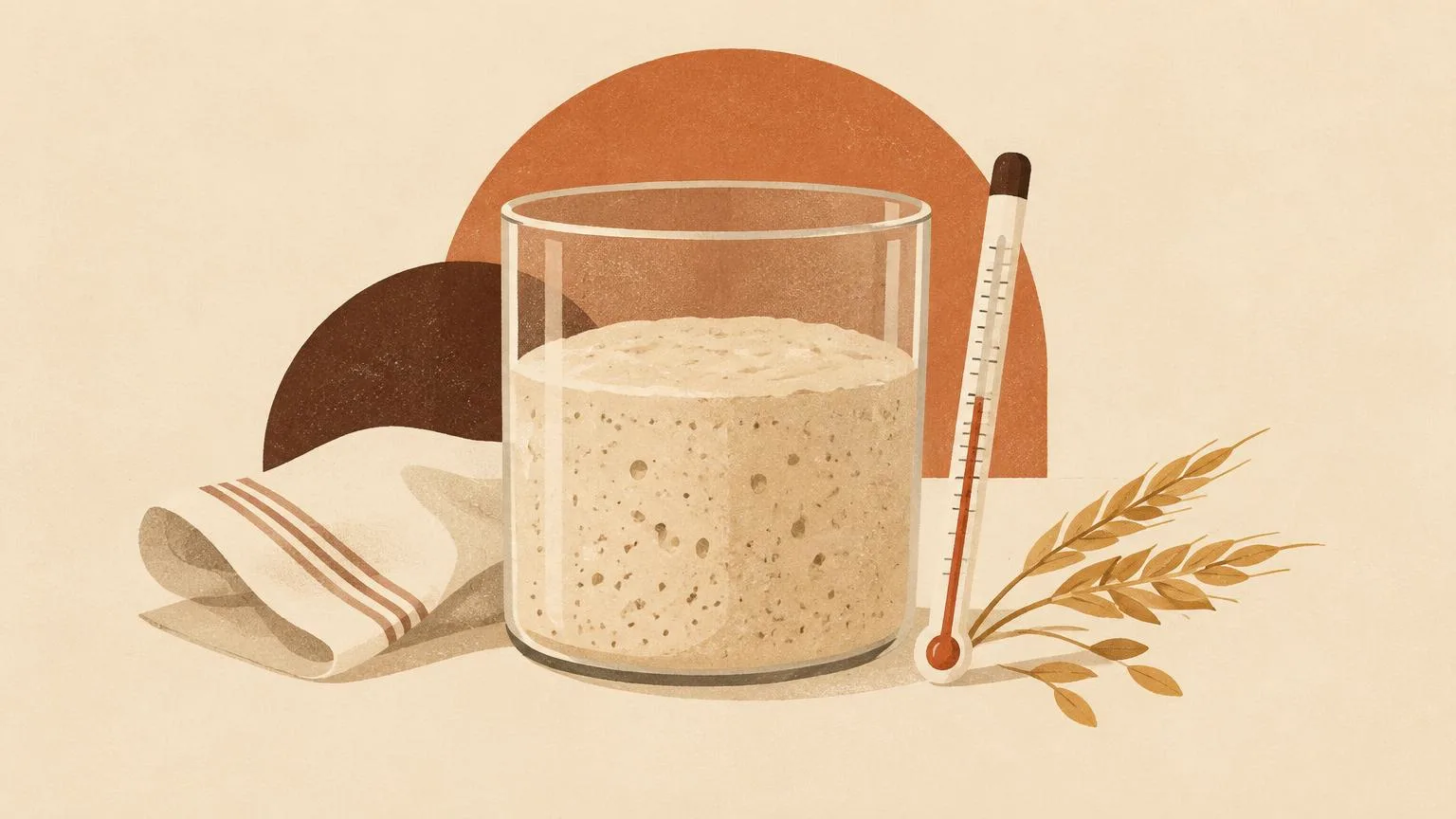
Bulk in a straight-sided, transparent container and note where the dough lands each bake. Same container, same starting height, same target line means your 50–75% call is consistent even when the kitchen sits at 18°C one week and 24°C the next.
How do I maintain a stable dough temperature without a proofer?
Cheap ways to hold temperature through a Swedish winter
Mix with warm water to hit your target dough temperature: if your flour sits at 18°C and the kitchen is cold, water at 25–28°C usually lands the dough near the ~25°C target; only with genuinely cold flour (around 15°C or below) go a few degrees warmer, never above about 35°C, and you adjust based on what your thermometer says rather than a chart. An oven with only the light on holds roughly 25–28°C, and a closed oven traps the heat from a switched-on lamp for hours, so put the dough in a covered bowl inside. An insulated option works too: a cooler box with a jar of warm water, or a thick towel wrapped around the bowl, slows the drop through a long bulk. If the kitchen runs warm instead, cold proof in the fridge once bulk hits the shape and strength you want. Whichever method you pick, the dough temperature at the start and end of bulk is the number that tells you whether it actually held.
Why room temperature is the wrong number to track
Room temperature is a guess at what your dough is doing. Flour starts cold, water is whatever you set it to, and friction from mixing adds a degree or two. The dough temperature is the number your percentage adjustments actually depend on.
Stick a thermometer into the dough right after mixing and again at the end of bulk. That difference tells you whether your insulated container is holding or drifting, and it becomes the note that makes next week's bake repeatable.
When should I choose cold bulk fermentation over warm?
Pick cold bulk (18–22°C) when flavor is the priority and your schedule is flexible. Long, slow fermentation builds more acidity, which reads as deeper tang and better keeping quality. Pick warm bulk (26–30°C) when you want maximum oven spring and a same-day loaf; yeast activity peaks there, so the dough rises fast and predictably.
A useful check either way: aim for a 50–75% rise before shaping (30–50% if the dough goes into an overnight cold proof). Doubling is an unreliable general rule and often leaves the dough over-fermented.
Hybrid schedules: warm start, cold finish
The compromise most weekly bakers land on: 2–3 hours warm to get bulk moving, then into the fridge overnight. You get predictable timing, developed flavor, and shaping fits around work.
How do I make the temperature adjustment stick from bake to bake?
The adjustment only works if the next bake starts from recorded data instead of memory. After a few weeks of weekly bakes, you stop guessing whether 26°C meant 30% less time last time; you look it up.
What to write down after every bake
Four fields are enough: dough temperature at the start of bulk, the temperature band you used, the % time adjustment you applied, and how the crumb and oven spring turned out. Add starter percentage and water temperature if you rebalanced to hit a target. One line per bake, written while the loaf cools, beats a paragraph written three days later.
Notes apps vs a bake journal
Scattered notes fail because the dough temperature never sits next to the result. Notion or Obsidian can hold anything but demand you build the structure yourself. A bake journal is built around bakes rather than blank pages.
DEGA records each bake with temperature and results attached, so the next bake starts from what actually happened. Its dough temperature calculator suggests a water temperature for your target; the band adjustment is still yours to choose and log.
FAQ
Does bulk fermentation take longer in a cold kitchen in winter?
Yes, substantially. A 4-hour bulk at 24°C can stretch to 6 hours or more at 18°C, since colder bands add roughly 40–60% to the baseline time. Gluten also develops more slowly, so structure builds late. Either extend the bulk, raise your starter percentage, or mix with warmer water to pull the dough temperature up.
Can I bulk ferment sourdough in the fridge overnight?
Not from the start. The practical version is a hybrid schedule: 2–3 hours warm to get fermentation moving, then into the fridge overnight to finish. You get predictable timing, developed flavor, and shaping that fits around work. Fridge-only from mixing works best when the dough has already hit the strength and shape you want.
What dough temperature should sourdough be for bulk ferment?
For standard weekly bakes, aim for 24–28°C dough temperature. For flavor-forward cold bulk, 18–22°C gives lactic acid bacteria more relative influence, producing a tangier crumb. There is no single ideal number: the right range depends on your schedule and the taste you want, not on a printed chart.
How much faster does sourdough ferment at 25°C vs 20°C?
Roughly 20–30% faster, based on the band adjustment: a 4-hour baseline at 24°C becomes about 4 h 25 m at 20°C and stays near baseline at 25°C. The relationship is not linear, since yeast activity roughly doubles per 10°C rise, so extrapolating degree-by-degree will under-ferment your dough.
Should I add more starter or ferment longer when my kitchen is cold?
Both work; they trade off differently. More starter, say 20% instead of 10%, roughly halves the fermentation lag, letting you accept a cooler dough and still finish bulk in reasonable time. Fermenting longer costs hours but deepens flavor. The starter route tastes tangier and demands closer attention near peak.
Sources
Stop guessing next bake.
DEGA logs dough temperature, rise and time for every bake, so the next one starts from what actually happened.
Get DEGA – SEK 5914-day money-back guarantee. Not for you? Email support@mydega.com within 14 days and you get a full refund.